The very fact that Delicious allows those with a registered account to publish a list of websites to others who in turn can share or comment on, thus creating a social space, propels this service into Web 2.0 technology. More-over, the delicious add-in for web-browsers such as Firefox , mean bookmarks saved on our web browser can be exported instantly to our Delicious account.
The use of tags in Delicious is a user generated attempt to provide keywords describing the content of the site (no different to tagging one of your friends in a photograph on facebook to describe who is in the photo), usually with no more than one or two words. Although highly subjective, tagging adds the metadata needed to loosely classify all websites visited by members of that social space. Delicious offers uses a list of the most popular tags used for a particular website providing it has been visited before, and we can add our own depending on what we feel best describes the content of the web page. This aggregation of tags within Delicious builds up a 'folksonomy'.
A folksonomy is a system of classification derived from the practice and method of collaboratively creating and managing tags to annotate and categorize content;[1][2] this practice is also known as collaborative tagging, social classification, social indexing, and social tagging.[citation needed] Folksonomy, a term coined by Thomas Vander Wal, is a portmanteau of folk and taxonomy.http://en.wikipedia.org/wiki/Folksonomy Accessed 14-11-2010
Folksonomies became popular on the Web around 2004[3] as part of social software applications such as social bookmarking and photograph annotation. Tagging, which is one of the defining characteristics of Web 2.0 services, allows users to collectively classify and find information. Some websites include tag clouds as a way to visualize tags in a folksonomy.[4]
Once we build up our bookmarks, add tags, and interact with others in the social space, commenting and offering more insightful words to tag websites with, interesting things happen (as with most social spaces, the network effect starts to become apparent). We can 'explore tags' and are presented with a 'tag cloud' displaying all the most popular tags or latest being used.
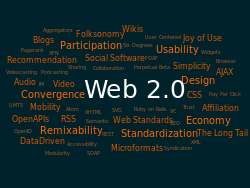
Typing in a word will display the latest websites bookmarked with that tag and thus trends emerge. This 'trending of tags' applied to websites can guide us to topics currently being viewed and bookmarked most frequently, which typically appear larger and more central in the cloud. Delicious goes further and highlights the popular tags in green used by you on your bookmarked sites. Are you using trendy tags for trendy sites ??? You are cool !! (or you need to get out more...).
If you are a web designer, adding web pages, menus, navigation systems etc. and trying to consider how best to tag and categorise your sites content, a visit to Delicious.com could give you some pointers to the most popular keywords being used and help guide you on your labelling system.
Information architects must try their best to design labels that speak the same language as a site's users while reflecting it's content. And, just as in dialogue, when there is a question or confusion over a label, there should be clarification and explanation. Labels should educate users about new concepts and help them quickly identify familiar ones. (Moreville and Rosenfeld 2006 p. 83
Beware then labeling your sites content with tags gleaned from Delicious ! Allowing the social network community to tag at will has it's drawbacks. Within the social space of Delicious.com, the network effect of 'power in numbers' with more users tagging the same website, thus popularises them. When adding a new bookmark, a list of popular tags is presented which you can quickly use to tag the site, so use of shared tags becomes fairly quick and users can think, "ok, the suggested most popular tags all look pretty good to me, lets just use those to tag this site. I have no time for this metadata lark."
An analogy of this approach in the traditional physical world of a reference library: letting the students of a university (by no means un-intellegent members of society ?!?) loose on a their university library catalogue, allowing any of them to tag a book with a set of terms they feel most encapsulates its content, instead of a qualified librarian with 10 years experience, and a system like the FRBR (Functional Requirements of Bibliographic Records), "created under the auspices of the AFLA [1]. It is a framework for relating data elements in bibliographic records to the needs of the users of those records." Chowdhury 2007.
Would we be able to run a keyword search on the catalog, using tags created by students and find the book we wanted? Maybe we would, maybe we would discover books more relevant than if we had used the traditional approach proposed in the FRBR, the question is open to the floor.
The approach to categorising content through the efforts of a social network and sharing ideas of what a website could be tagged has the positive notion of allowing democracy to prevail, most popular tag wins, maybe we could see a future where the members of government will be elected to power through tagging on a "facebook for your next MP" or something similar? Interesting concept.....but then that is coming in my opinion, but we are jumping into the realms of Web 4.0 and beyond, and I shall post my critique in due course.
[1] AFLA: The International Federation of Library Associations and Institutions (IFLA) is the leading international body representing the interests of library and information services and their users. It is the global voice of the library and information professionhttp://www.ifla.org/ Accessed 14-10-2010
References (print only listed)
Chowdhury G. G., & Chowdhury S., (2007). Organising Information: from the shelf to the web. London; Facet
Morville, P., & Rosenfeld, L. (2006). Information architecture for the world wide web (3rd ed). Bejing; Farnham: O'Reilly

No comments:
Post a Comment